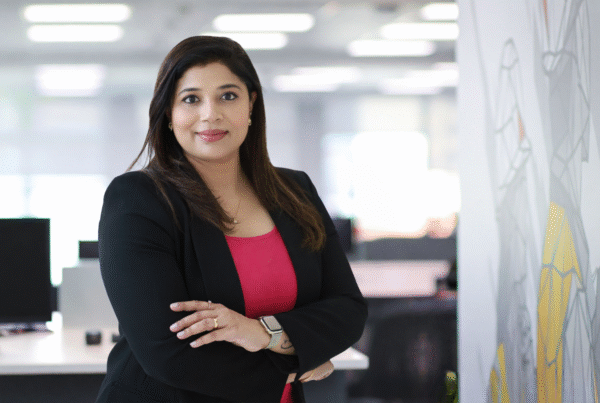

We are proud to share that Mbalenhle Zwane, Principal Mechanical Engineer at 9E Global, has been featured in the **March 2026 issue of ITP MEP Middle East as part of their Women in MEP feature.
The publication highlights women shaping the future of the MEP industry across the region. In this interview, Mbalenhle shares her insights on representation in engineering, the importance of cross-industry curiosity, and her hopes for stronger female leadership across GCC mega-projects in the years ahead.
Below are the interview questions and Mbalenhle’s responses:
What are two unspoken regional challenges women in MEP face, and what is your go-to strategy for overcoming them? – One of the unspoken challenges women in MEP face is representation, or the lack of visible women role models and peers. This is not unique to the Middle East, as MEP has historically been a male-dominated industry worldwide. In the Middle East, however, this challenge is shaped by a unique regional dynamic; while the industry itself is well established, systemic efforts to integrate and elevate women in technical and leadership roles are relatively recent but are progressing quickly. My go-to strategy has been to seek out and engage with the women who are present in the industry. Joining the Women in ASHRAE Falcon chapter was a solution for this region. It has allowed me to quickly build a tangible professional network and gain visibility while giving me an opportunity to contribute to meaningful solutions alongside organizations such as WIBSE that are driving change in the region.
In an ideal world, what personal task would you want AI to handle for you? – In an ideal world, I would want AI to take care of my personal administration and everyday logistics. While I’m generally well organised professionally, keeping personal tasks such as household scheduling and planning, running errands, and personal documentation consistently up to date can surprisingly feel like climbing the steep 35-degree ascent of Wadi Ghalila. An AI assistant that could manage grocery planning without manual input from me, coordinate purchasing, and even support basic food preparation would free up valuable mental space and create time to invest in other activities that make life more meaningful.
What recent achievement in your role are you most proud of, and what key decision made it possible? – I am most proud of successfully leading and delivering two stages of a multi-disciplinary design package for an iconic project aimed at being a first-of-its-kind, luxurious development. The packages included four core engineering packages and six specialist packages. It was rewarding to navigate complex challenges under tight time constraints while maintaining the quality and innovation the project demanded, a feat I could only achieve with the support of an exceptional collaborative team.
What’s one piece of advice you wish someone had given you early in your MEP career? – One piece of advice I wish I’d received early in my MEP career, and one that I try to pass down to young engineers, is to look beyond the boundaries of the MEP industry. Not everything that shapes MEP is learned in a classroom or found in a textbook. Develop a curiosity for global economic cycles, regional political shifts, emerging technologies, and developments in parallel industries such as energy, sustainability, manufacturing, and digital infrastructure. All these have a direct impact on how our work in the MEP industry evolves. Staying curious and informed about these wider influences helps build adaptability and sustainable future proof solutions. The ability to transfer insights from other industries is incredibly valuable and can set you apart far earlier than technical expertise alone.
If you could change one thing about how women are perceived or supported in MEP, what would it be? – I would link this to the unspoken challenge of representation I mentioned earlier. Women should receive greater societal recognition for the value they bring to iconic projects, especially in a region known for its unique and groundbreaking developments, as well as for their contributions to the MEP industry and the roles they fill within their organisations. This recognition shouldn’t be reserved for special occasions like Women’s Day or Women in Engineering Day; it should become part of the daily narrative, evolving to a point where we celebrate the work, rather than the gender of the person doing it.
Looking ahead to 2030, what is your boldest hope for women leading MEP innovation across GCC mega-projects and smart cities? – In an article titled Advancing Gender Equity in the Middle East Workforce wherein 1,150 professional men and women across 25 of the largest GCC organisations were interviewed, it was cited that women occupy less than 7 % of board seats across the GCC compared with about 20 % globally and only a small minority of senior management posts. I hope that by 2030, women will lead a meaningful percentage of multidisciplinary project teams on iconic developments. This would ensure that GCC projects fully benefit from the diverse perspectives and problem‑solving approaches women bring to complex engineering challenges.
MEP Middle East: https://www.mepmiddleeast.com/power-lists/women-in-mep/women-in-mep-beyond-barriers